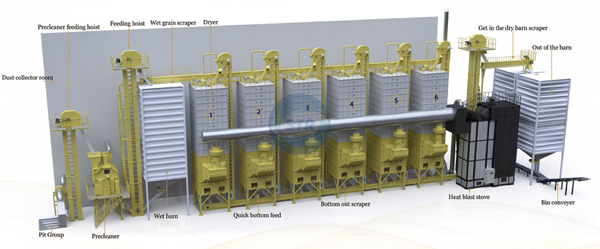
System Technical Specifications
Complete technical parameters for 192 tons complete drying line system
| Parameter | Specification |
|---|---|
| System Type | Complete Grain Drying Line with Traditional Low-Temperature Circulating Technology |
| Total Batch Capacity | 192 tons (6 dryers × 32 tons each) |
| Dryer Model | 6 × 5HHL-32 Low-Temperature Circulating Dryers |
| Furnace Model | 1 × Biomass Furnace (size configurable based on fuel type) |
| Hot Air Temperature | 50-70°C (adjustable) |
| Maximum Grain Temperature | 30-40°C |
| Total Power Consumption | Approximately 116.1 KW (6×19.35KW) |
| Drying Rate (Moisture Removal) | Generally 0.6%-1.0% per hour |
| Rice Fissure Rate | ≤3.0% |
| Fuel Types | Biomass, coal, oil, gas, natural gas, hot gas, rice husk |
| Control System | Centralized control with individual dryer automation |
| Daily Processing Capacity* | Approximately 192-384 tons (1-2 batches) |
| Monthly Processing Capacity* | Approximately 5,760-11,520 tons |
| Applications | Rice, wheat, corn, soybean, barley, sorghum, rapeseed, sunflower |
*Based on 20 hours daily operation, 30 days monthly operation. Capacity depends on grain type, initial moisture, and batch cycles.
Complete System Configuration
Detailed components of 192 tons complete drying line
Drying System (6 Units)
6 × 5HHL-32 Traditional Low-Temperature Circulating Dryers, each with 32 tons batch capacity, 50-70°C hot air temperature, and comprehensive safety systems.
Heat Source System
1 × Biomass furnace capable of supplying sufficient hot air to all 6 dryers simultaneously. Configurable for multiple fuel types including biomass, coal, gas, etc.
Conveying System
Complete grain handling system including bucket elevators, screw conveyors, distribution augers, and discharge systems for automated material flow.
Dust Removal System
Centralized pulse dust collector with ducting to all dryers. Ensures clean operation and meets environmental standards for commercial facilities.
Control System
Central control panel with individual dryer controls. Each dryer has its own computerized moisture detector, temperature regulator, and safety systems.
Building Structure
Recommended building design with minimum 16m eave height, adequate floor space for 6 dryers, and proper ventilation for safe operation.
System Features & Advantages
Advanced features for industrial-scale grain drying operations
One-Touch Operation, Automatic Running
Each dryer features simplified automated operation with one-touch start. Reduced labor requirements and consistent, repeatable drying results across all 6 units.
Large Processing Capacity, Industry Leading
192 tons total batch capacity provides extremely high throughput for commercial operations. Industry-leading capacity for traditional technology drying systems.
High Rice Yield Rate, Optimal Rice Quality
Traditional low-temperature circulation technology minimizes grain damage. Each dryer achieves ≤3.0% fissure rate, ensuring superior milling quality and high head rice yield.
Multiple Safety Designs, Secure Operation
Each dryer includes full-level switch, computerized moisture detector, automatic temperature regulator, timer switch, air pressure switch, and abnormal overheat alarm for comprehensive safety.
Energy Saving, Cost Reduction
Central biomass furnace reduces fuel costs compared to individual heating systems. Efficient thermal design and optimized airflow reduce overall energy consumption.
Stable Performance, Durable & Long-Lasting
Traditional technology with proven reliability. Robust construction ensures stable performance in harsh working environments with extended service life and minimal maintenance.
Flexible Operation Modes
System can operate all 6 dryers simultaneously, in staggered batches, or individual units as needed. Provides operational flexibility for varying throughput requirements.
Scalable Design
Modular design allows for future expansion. Additional dryers can be added to the system as business grows, protecting initial investment.
System Layout & Design
Optimized layout for efficient 192 tons complete drying line
Typical Layout Configuration
Layout Requirements:
Suitable Applications
Designed for large-scale commercial grain processing operations
National Grain Reserves
Government grain reserve facilities requiring high-volume, reliable drying for strategic food security.
Large Processing Plants
Major rice mills, flour mills, and grain processing facilities with daily throughput over 200 tons.
Port Export Terminals
Grain export facilities at major ports requiring rapid, high-volume drying before international shipment.
Agricultural Mega-Cooperatives
Very large farming cooperatives processing grains from thousands of member farms with centralized facilities.
Corporate Farming Operations
Large corporate farms with 1,000+ hectares of grain production requiring industrial-scale processing.
Biofuel & Industrial Plants
Large-scale ethanol plants, breweries, distilleries, and animal feed manufacturers with massive grain intake.
Supported Grain Types:
Fuel Options
Multiple fuel compatibility for operational flexibility and cost optimization
Fuel Selection for Large Systems: For 192-ton systems, biomass and rice husk offer the best economics, reducing fuel costs by 50-70% compared to diesel. Central furnace design allows bulk fuel handling and automated feeding for efficiency.
Cost-Benefit Analysis
Economic advantages of 192 tons complete drying line system
Massive Throughput Efficiency
192 tons per batch enables processing of entire harvests quickly. Reduces holding time, spoilage risk, and inventory costs significantly.
Economies of Scale
Central furnace and shared infrastructure reduce per-ton operating costs. Bulk fuel purchasing provides additional cost advantages.
Labor Efficiency
Automated operation reduces labor requirements. One operator can manage the entire 6-dryer system with proper controls.
Premium Grain Quality
≤3.0% rice fissure rate preserves grain quality, resulting in higher market prices and better customer satisfaction.
Typical Economic Performance (192-ton system)
*Based on 20 hours daily operation, 30 days monthly operation, rice drying from 22% to 14% moisture, using biomass fuel at 80% capacity utilization.
Investment Comparison: 192-ton System vs Individual Units
192-ton Complete Line
- Single centralized furnace (lower cost)
- Shared infrastructure (elevators, ducts)
- Bulk purchasing discounts
- Lower per-ton installation cost
- Reduced operational labor
6× Individual 32T Units
- 6 individual furnaces (higher cost)
- Separate infrastructure for each
- No bulk purchase advantages
- Higher per-ton installation cost
- More operational labor required
Complete system typically provides 20-30% lower total cost of ownership
Complete Line Comparison
Comparing traditional series complete drying lines
| Parameter | 192-ton Line (Traditional) | 210-ton Line (New Developed) |
|---|---|---|
| Technology | Traditional Low-Temperature Circulating | New Double-Sided Mixed-Flow |
| Total Batch Capacity | 192 tons (6×32T) | 210 tons (6×35T) |
| Drying Temperature | 50-70°C | 45-55°C |
| Drying Efficiency | Standard speed | 35% faster |
| Rice Fissure Rate | ≤3.0% | <3.0% |
| Building Height | ~16m eave height | ~13m eave height |
| Control System | Semi-automatic, individual controls | Fully automatic 3D PLC centralized |
| Best For | Cost-sensitive large operations | Premium large-scale operations |
| Investment Level | Economical | Premium |
Industrial-Scale Drying Solution
The 192 Tons Complete Drying Line represents the ultimate in traditional technology grain drying for massive commercial operations. Contact our engineering team today for a customized system design, detailed quotation, and comprehensive ROI analysis.